

Commentary
Nathan J. Brown
{
  "authors": [
    "Nathan J. Brown"
  ],
  "type": "commentary",
  "blog": "Diwan",
  "centerAffiliationAll": "",
  "centers": [
    "Carnegie Endowment for International Peace",
    "Malcolm H. Kerr Carnegie Middle East Center"
  ],
  "englishNewsletterAll": "",
  "nonEnglishNewsletterAll": "",
  "primaryCenter": "Malcolm H. Kerr Carnegie Middle East Center",
  "programAffiliation": "",
  "regions": [
    "Lebanon",
    "Israel"
  ]
}
Source: Getty
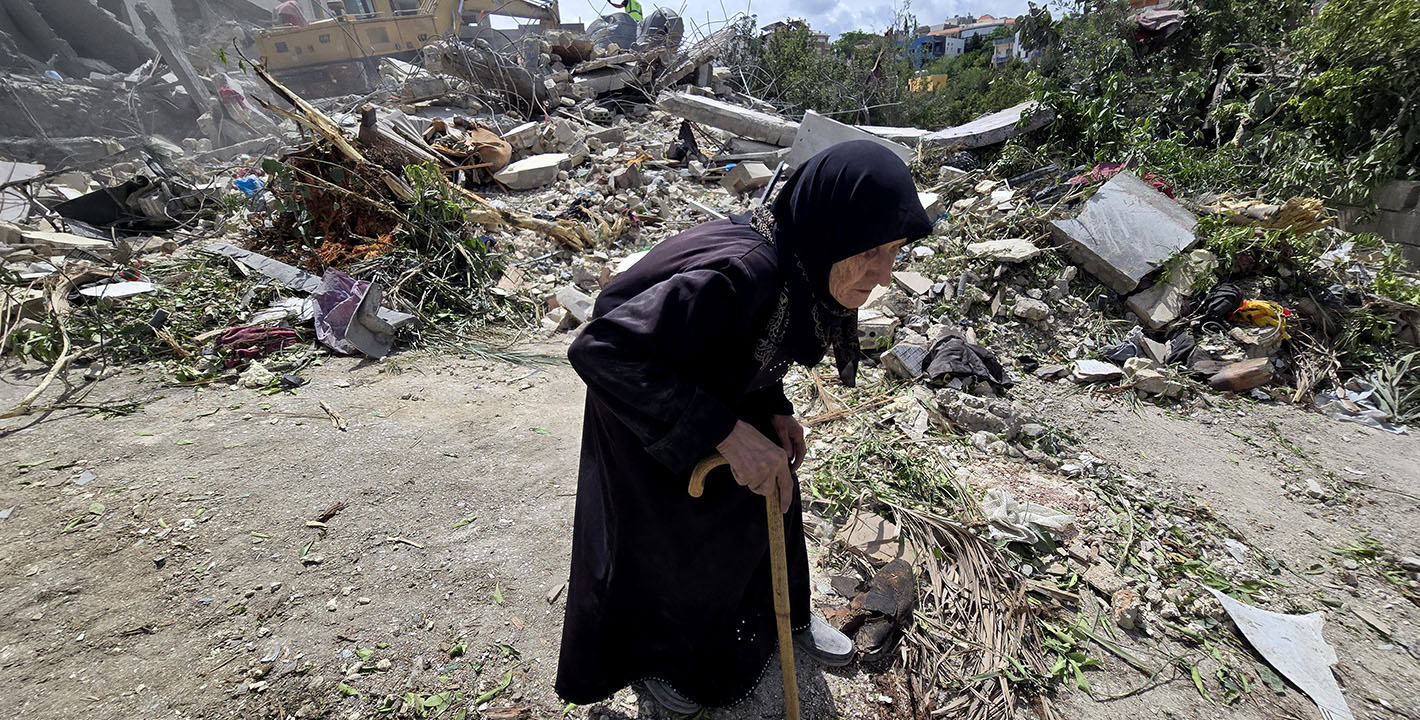
Adversaries are to be degraded so deeply, that reconstitution becomes difficult or impossible.
Since October 7, 2023, Israel has undertaken military actions in Gaza, Lebanon, the West Bank, Syria, Iraq, and Iran. It has relocated populations, destroyed enormous expanses of housing, schools, and infrastructure, and with a death count close to six digits. The attacks of October 7, with their gruesome loss of life, and previous decades of intermittent fighting on the Gaza and Lebanese fronts, form a background to this quantitative and qualitative shift. But Israel’s policy cannot be reduced to drift, rage, improvisation, or Israeli Prime Minister Benjamin Netanyahu’s opportunism. All are present, but something more profound is at work.
What has emerged is a new approach to Israeli security, one of dominance without settlement, degradation without reconstruction, territorial denial without a political horizon, and war not as a bridge to an arrangement but as the arrangement itself. The danger is not that Israeli leaders have acted without regard to the consequences. The danger is that they embrace those consequences. So I have been arguing since shortly after October 7. But what has been observable in a piecemeal fashion, and treated as unintended, is now clear and more broadly acknowledged as a strategy.
And it requires a series of blunt statements to describe.
The first is that this is intentional and explicit. The architecture was visible almost from the beginning and has become increasingly unequivocal: destruction, buffer zones, non-return, non-rebuilding, continued Israeli security control, degraded governance, and the prevention of adversarial reconstitution. The only thing that has expanded is its scope. The logic appeared first in Gaza, before spreading to areas of the West Bank. It now encompasses major parts of Lebanon and smaller parts of Syria, and in a different way even Iran. Adversaries are not simply to be deterred, defeated, or bargained with; they are to be degraded so deeply, and their environments so reshaped, that reconstitution becomes difficult or impossible.
Such conclusions are not efforts to guess Israeli intent, they reflect what is being publicly expressed in Israel. Read one recent—and unexceptional—English-language account of what a Jerusalem Post journalist has dubbed the “Rubble Doctrine.” A Lebanese town reduced to rubble is not presented merely as an unfortunate result of fighting. Rubble itself has become part of Israel’s security concept. That is why the old complaint that the country has “no day-after plan” always missed the point. Rubble has become the doctrine, not the byproduct.
In retrospect, some officials in the Biden administration said they saw these outcomes and warned that Israel was courting disaster. In the words of one of them, the most likely consequence was “Jenin on steroids,” in that “the guns would fall silent, hostages would come home and humanitarian aid would trickle in—but there would be no agreement or momentum for what came next.” But if they saw the result clearly, they completely misled themselves into thinking that this was an outcome to warn against. In fact, it was regarded by Israeli leaders—openly, explicitly, and repeatedly—as a strategic opportunity (though not one in which the guns would be completely silent).
A second statement is that, yes, Hamas bears responsibility for October 7, but that is not a license to ignore the laws of war. Hamas has certainly helped bring this catastrophe into being. The atrocities of October 7 were acts of murderous cruelty toward many, many victims, and exhibited catastrophic political irresponsibility toward Palestinians themselves. I have put the point before in deliberately harsh terms: those who strike a hornet’s nest cannot escape accountability for what follows. Even if they held abhorrently dehumanizing views of their enemies, Hamas leaders should have had a more serious reckoning with what they were unleashing. October 7 exposed Israeli vulnerability, but also triggered events that Hamas could not control, and from which Palestinians have suffered overwhelmingly.
Yet that responsibility is not a moral alibi for everything Israel has done. It does not turn intentional destruction on a massive scale—and with staggering casualties—into regrettable but unintentional collateral damage. It does not turn forced population movements into legitimate security management. It does not turn conquest and domination into self-defense. It does not make the civilian populations of Gaza, the West Bank, and South Lebanon individually and collectively responsible for the political and military decisions of those who claim to act in their name.
Third, this is not just about Benjamin Netanyahu. Netanyahu matters. His coalition matters. His political survival matters. His willingness to indulge, empower, and depend on the most extreme forces in Israeli politics matters. But reducing the shift to Netanyahu is misleading. The broader movement includes military doctrine, public opinion, centrist security thinking, opposition silence, the collapse of confidence in deterrence, and a post-October 7 consensus that Israel must not only deter adversaries, but also prevent them from reconstituting themselves. A post-Netanyahu Israel might manage Washington better. But it is unlikely to simply return to the old approach. The problem is not only Netanyahu’s extremism, it is the normalization of a security logic that now extends well beyond him.
Fourth, yes, this time things are different. Some see Israel, or even Zionism itself, as inherently about violent expansion and imposition, without diplomacy or negotiation. I do not. Israeli strategy was never gentle. The state’s founding involved mass expulsion. Later decades brought occupation, settlement, punitive raids, sieges, assassinations, intelligence dominance, and a willingness to use overwhelming force.
However, earlier Israeli strategy also included the idea that force might deter war in the short run and later culminate in a political arrangement. War was still often explained as a means of achieving something else: deterrence, diplomacy, territorial compromise, normalization in the form of full diplomatic relations, or at least a more stable status quo. Israeli leaders complained for years that their Arab counterparts would not deal with them. But after tough negotiations, there were peace treaties with Egypt and Jordan. There was a willingness in the 1990s to deal with Palestinians as a nation. In the 1990s and early 2000s, two Israeli leaders (one leaning left and the other right) engaged in serious efforts to reach a peace agreement with Syria.
That is history. Now it is the Syrian president who openly makes overtures to Israel that he claims have gone unanswered. Israel has unilaterally shredded the half-century-old disengagement agreement with his country. Jordanian and Egyptian leaders no longer have the sense that their peaceful relations are sacrosanct with Israeli leaders. Peace treaties and diplomacy with former adversaries are no longer the central goal for Israel. Diplomacy still matters, but increasingly as a means of managing, legitimating, or consolidating coercive realities, not as a path toward mutual recognition or political settlement. Peace, if it appears at all, is secondary to domination and denial. Diplomacy has not disappeared. But it increasingly functions as a tool for managing the battlefield, not as an alternative to it.
Fifth, the Israeli political spectrum has shifted. If one wants to know what the far left says, listen to the political initiative named A Land for All, which calls for “a confederal model, grounded in international law, local needs, and hard-earned lessons from decades of failed negotiations.” If one wants to know what the moderate Zionist left says, the answer is often silence. It is morally alarmed, politically homeless, and strategically speechless with the Oslo process’ demise.
Israel’s center, in turn, is not a peace camp. Security-oriented discussion now focuses on a regional role for Israel, buffer zones, the relocation of Palestinian populations, islands of Palestinian autonomy operating under Israeli and sometimes Arab oversight, and formal political arrangements only with those who ratify these objectives. There is sometimes talk of “restoring deterrence,” but it is not clear what that means beyond acceptance of Israel’s strong regional role.
The right is represented by Bezalel Smotrich’s “decisive plan, which calls for ”annexation, the removal of Palestinians as a national-political obstacle, permanent residency at best for Palestinians and expulsion for those who do not like the arrangement.” That is why much outside commentary misses the point. A few commentators abroad still wonder when Israel will return to a two-state process, whether a more moderate government will revive diplomacy, or whether the day after will bring some technocratic reconstruction formula. However, the question debated most often within the country is not how to end domination. It is how to administer it.
Sixth, for most Israelis, Palestinians are a nuisance but no longer a nation. Dealing with Palestinians as a nation—the real innovation of the Oslo Accords—has become a marginal concern of the left; apartheid is the middle position; expulsion is the right-wing position. I am not exaggerating.
In mainstream Israeli Jewish politics, the center of gravity is not equality, sovereignty, or negotiated self-determination. It is how to manage Palestinian inhabitants in the West Bank and Gaza, ensuring calm without granting them sovereignty or citizenship. And it is to restore elements of the Oslo period that involved some self-governance and cooperative Palestinian leaders, but as a dead end, not a road to a permanent agreement between Israelis and Palestinians.
On Israel’s right are plans for expulsion, territorial emptying, and the removal of Palestinians as a political and demographic obstacle. That position is now part of Israeli political debates, opposed by the center since such a policy will lead to international opprobrium without bringing calm. But even those opponents think not in terms of Palestinian national rights but the best way to have Palestinians administer their own internal affairs within isolated islands. The decay of Palestinian national institutions is profound, and will be difficult to reverse.
Seventh, some observers see the shift in Israel’s approach clearly. But why has it taken so long for so many to notice it? Many dismissed Israeli statements as products of trauma. Some Israeli statements were framed with detailed lists whose human implications were clear but not phrased in stark forms. In Arab states, other than the United Arab Emirates, anxiety about Israel’s shift is pronounced, but it is often softened in diplospeak by the desire to keep Washington on board—especially by flattering President Donald Trump and avoiding direct confrontation with an Israeli approach his administration has largely embraced.
However, outside of official circles, frankness is finally being heard. In Israel and among close observers of Israeli politics, those such as Dahlia Scheindlin, Meirav Zonszein, and journalists associated with the online magazine +972 sounded early and clear warnings. Some international analysts—Mouin Rabbani, Waleed Hazbun, Marc Lynch, and Yezid Sayigh—for instance, with different emphases and from different locations, have grasped that what is afoot is not simply an Israeli government failing to think through the consequences of its actions. While I do not embrace all their conclusions, we seem to be joined by our deep concern about Israel’s strategic posture, one defined by recurrent war, permanent domination, territorial denial, and degraded governance as a way of providing national security.
I have been trying to describe this shift since the first weeks after October 7, mapping a debate that is taking a very different shape from earlier ones. What is striking is not that this has suddenly become visible, but that it is becoming harder to describe as accident, drift, or unintended consequence.
Finally, eighth, this will likely end badly. A doctrine built on domination, degradation, and non-reconstitution has produced tactical successes. It has destroyed infrastructure, killed commanders and foot soldiers, depopulated zones, delayed attacks, imposed costs, and reassured frightened publics that something decisive is being done.
However, permanent war as a governing condition is not only bad for the region, even on its own terms it offers Israel little in the long run. Tranquility produced by rubble is not peace. It is only an interval before more rubble is required. This is the central flaw in the doctrine. It mistakes incapacitation for resolution. It assumes that if adversaries are degraded enough, if populations are fragmented enough, if political communities are denied enough institutional form, the underlying conflict can be managed indefinitely.
But a regional order built on dispossession, permanent insecurity, and repeated destruction will not become stable simply because it is called security. It will generate resistance, radicalization, international legal exposure, domestic corrosion, and further war.

Nonresident Senior Fellow, Middle East Program
Nathan J. Brown, a professor of political science and international affairs at George Washington University, is a distinguished scholar and author of nine books on Arab politics and governance, as well as editor of five books.
Recent Work
Nathan J. Brown
Nathan J. Brown

Israel is encroaching on the country’s territory, while the Lebanese look askance at one another.

Issam Kayssi
The party’s domestic and regional roles have changed, so Lebanon should devise a disarmament strategy that encompasses this.

Michael Young
In an interview, Marc Lynch discusses his new book decrying the post-1990 U.S.-dominated order in the Middle East.
Michael Young

Because perpetual conflict enhances control, offers economic benefits, and allows leaders to ignore popular preferences.

Angie Omar
A prerequisite of serious talks is that the country’s leadership consolidates majority national support for such a process.
Michael Young