

Commentary
Rym Momtaz
{
  "authors": [
    "Rym Momtaz"
  ],
  "type": "commentary",
  "blog": "Strategic Europe",
  "centerAffiliationAll": "",
  "centers": [
    "Carnegie Endowment for International Peace",
    "Carnegie Europe"
  ],
  "englishNewsletterAll": "",
  "nonEnglishNewsletterAll": "",
  "primaryCenter": "Carnegie Europe",
  "programAffiliation": "",
  "regions": [
    "Europe",
    "Western Europe",
    "Israel"
  ],
  "topics": [
    "EU",
    "Democracy",
    "Civil Society"
  ]
}
Source: Getty
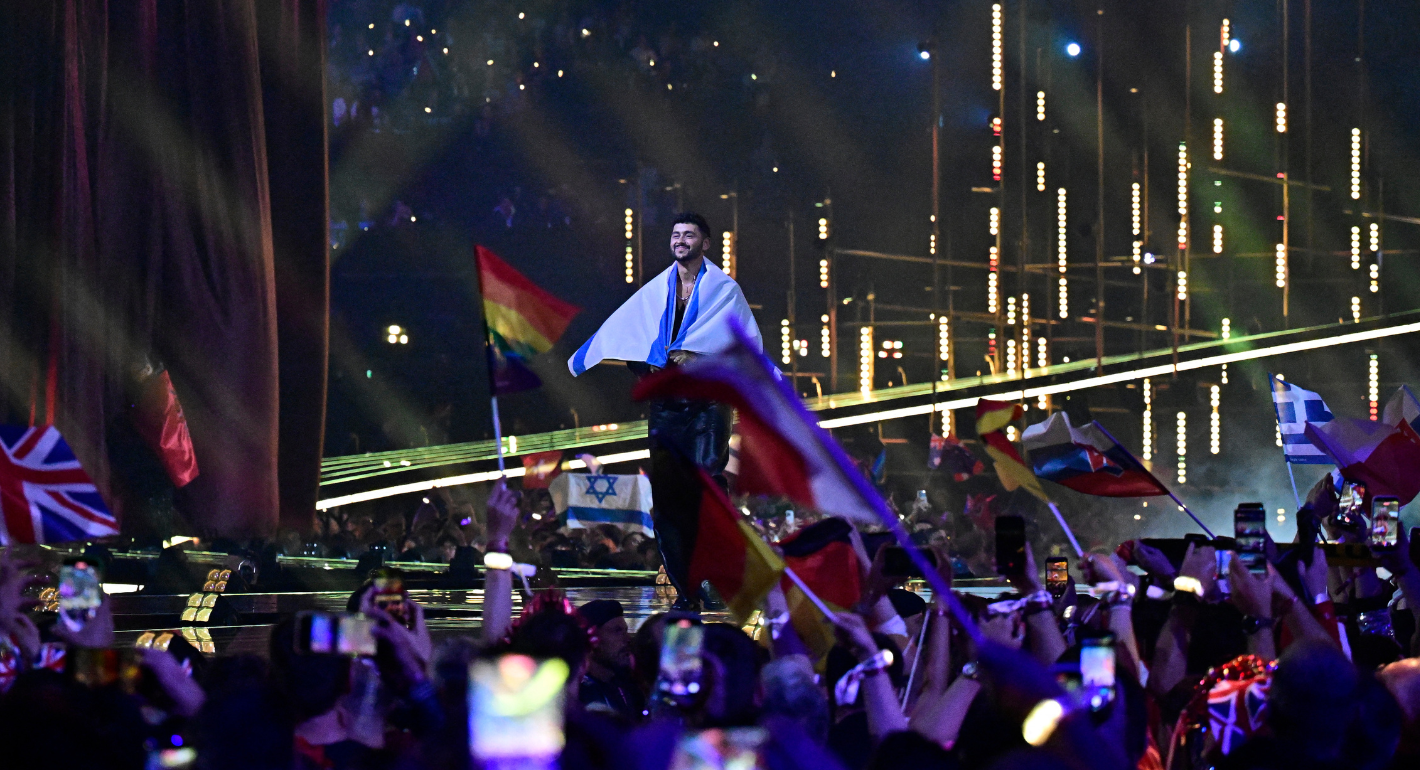
Five countries staged the biggest political boycott in Eurovision history over Israel’s participation. With the FIFA World Cup and other sporting or cultural touchstones on the horizon, are boycotts effective?
Research Fellow, Global Public Policy Institute
It would be hard to imagine a political strategy more deleterious to the human spirit and more damaging to the work of transforming and transcending protracted conflicts than the now-common attempt by the most joyless, literal-minded people in the world to make everything good and holy and lip-sync glittery into a proxy plebiscite on their political morality.
Maybe this all started on October 7, 2023, when Hamas butchered a peaceful music festival. Maybe it started when the Israeli government, led by Prime Minister Benjamin Netanyahu, spent the better part of a million dollars turning Israel’s Eurovision entry into a case study in public diplomacy. Or maybe it started in 1948, when the modern state of Israel was founded—or millennia before that, after all. It certainly did not start in 1956, when seven countries that had been at war for generations took the stage, side-by-side, in their last surviving shared language: kitsch.
You could try adjudicating the latest nonsense by parsing vote tallies and quotas instead of every dusty inch from the river to the sea, all safely removed from stakes or consequences. Or you can tune it all out, turn to the people and institutions on whose hard work a better world will be built—including the artists and musicians of Israel and Palestine and Israel’s independent public broadcaster, which clings on to the Eurovision Song Contest as though it were life itself—and hopefully save your soul.
Director of Data Projects and Institutional Relations, Institut de Recherche Stratégique de l'École Militaire (IRSEM)
The debate over whether Eurovision should exclude Israel from participation raises several political and symbolic issues. First, there is a question of consistency. In the name of international law and European values, Russia was excluded from Eurovision after invading Ukraine. For Iceland, Ireland, the Netherlands, Slovenia, and Spain, allowing Israel to participate despite its conduct in the war in Gaza is a double standard.
Second, there is the issue of effectiveness. Cultural boycotts rarely change military policy directly, but they can contribute to broader international pressure when few concrete levers exist beyond punitive measures such as suspending the EU-Israel association agreement. In that sense, Eurovision becomes a symbolic arena where Europe expresses political and moral boundaries.
The issue is particularly sensitive because Eurovision matters deeply in Israel. It is highly followed and tied to the country’s sense of self. The Israeli state has also used the contest as part of its public diplomacy and hasbara strategy through large-scale communication campaigns.
Recent images of Israeli soldiers playing Eurovision songs during raids, or the interception of humanitarian boats bound for Gaza, further reinforce the perception that the contest has become politicized. Supporters of a boycott therefore see it as a low-cost, symbolically powerful way for Europe to pressure Israel.
Project Coordinator, OSW Centre for Eastern Studies
For the past four years, Russia has remained mostly excluded from international events in sports and culture. This doesn’t affect Moscow’s ability to sustain the war and has little influence on its policies. What it does do, however, is signal to the Russian people that the situation is fundamentally unacceptable and that as long as the war continues, business as usual will not be possible.
It is not an attempt to cancel Russia, diminish its achievements, or indeed deny its right to exist. It is a tool: purposeful, measured, temporary, and constituting part of a broader effort to bring about a change in Moscow’s behavior. Once the war ends under terms acceptable to the attacked party, the boycott will lose its purpose.
The same logic underlies calls to exclude Israel from events such as Eurovision. In this case as well, it forms part of a—much weaker and at best half-hearted—international effort to hold Israel accountable for its violations of international humanitarian law and pressure it to change its conduct. Contrary to rhetoric coming from Tel Aviv, nothing extraordinary is being demanded of it. Remaining within internationally-recognized borders and respecting legal obligations it has ratified or otherwise explicitly recognized would suffice.
As such, calls for a temporary boycott of Israel are neither surprising nor extraordinary.
Deputy Director, Carnegie Europe
Yes, boycotting Eurovision over Israel’s actions in Gaza was the right decision. More countries should have done it.
Spanish Prime Minister Pedro Sánchez is right that the decision put his country—and the others that boycotted—“on the right side of history.” But the partial boycott is also a reminder that, without unity, these actions serve a limited purpose.
The end of South Africa’s apartheid shows that international pressure can be effective—but it must be representative and sustained. Russia has been banned from Eurovision since 2022, and that unanimous move, together with the football ban that the Union of European Football Associations (UEFA) imposed on it, stripped Moscow of a key form of soft power.
A partial boycott of one cultural event, such as the one at Eurovision this year (Israeli teams are not banned from UEFA competitions), does little to curtail Israel’s international soft power. It damaged primarily the contest itself, whose values of unity through music have been tarnished and whose financial stability has been endangered. It also reminded European audiences, whose support for Tel Aviv’s policies is in decline, of another front of disunity. Be it in football, singing contests, or trade sanctions—when faced with atrocities on its doorstep, Europe still seems to have no capacity for effective action.
Director, European Middle East Project
There are arguments both for and against cultural boycotts of states committing grave international crimes. What is harder to defend are blatant double standards.
Russia was swiftly suspended from Eurovision and UEFA after its full-scale invasion of Ukraine. Israel, despite its destruction of Gaza and atrocities against civilians, remains in both. In Russia’s case, participation in sports and cultural events is said to be incompatible with fundamental values. With Israel, we are told that culture and sports should stay above politics, that boycotts won’t help the children in Gaza—or even that they are antisemitic. EU foreign policy chief Kaja Kallas says excluding Israel from Eurovision would “punish the Israeli people,” yet demands that the EU cut funding to the Venice Biennale because Russia’s participation would be “morally wrong” while it “bombs museums, destroys churches, and seeks to erase Ukrainian culture.”
Yes, the two cases differ in important ways. But international law and basic ethical standards do not. Israel’s violations are no less serious. And the argument that the country’s public broadcaster is more independent than its Russian counterparts does not hold. Meanwhile, Israel’s state-coordinated campaigns to boost voting support at Eurovision further weaken such claims. So yes, if excluding Russia from the contest was justified, then the same principle should apply to Israel.
Author of “Postwar Europe and the Eurovision Song Contest”
Boycotts of Eurovision have not ended dictatorships or wars. Rather, as with boycotts targeting any large event, they have principally leveraged the global media stage to put a spotlight on timely political causes.
Political boycotts have targeted Eurovision since 1969. Then, the Austrian national broadcaster ORF—ironically this year’s host—desisted from the contest held in Madrid under the right-wing dictatorship of Francisco Franco. Eurovision boycotts have since mostly been due to bilateral, usually military, conflicts: Greece and Turkey in the 1970s, and Georgia and Russia, Armenia and Azerbaijan, and Russia and Ukraine in the twenty-first century. Still, in a contest that has had 1,789 entries, there have only been eleven individual political boycotts—even though the stakes in boycotting the annual Eurovision are lower when compared to the more watched quadrennial Olympics or football World Cup.
The 2026 five-party Eurovision boycott was the largest ever. Security measures at this year’s contest were high, but they always are. The Vienna venue with a capacity of some 10,000 was sold out, as Eurovision usually is. Pro-boycott protests outside the venue attracted only a few thousand. Yet, amid thirty-five smashing entries, the boycott was the biggest media story in this year’s contest.
Senior Research Fellow, Clingendael Institute
The desire to keep high-profile cultural and sporting events politically neutral, meaning to welcome participants irrespective of the actions of their governments, can fail when these governments violate international law in major ways.
In such cases, public discussion and outrage at such countries’ participation reflect the sense that our collective moral conscience has been violated.
This was the case for Russia’s illegal war of aggression in Ukraine, but it also applies to the United States or the United Arab Emirates enabling mass slaughter in Gaza and Sudan. Regarding Israel, that same slaughter—which the International Court of Justice ruled as creating a significant risk of genocide—in Gaza is combined with a settler-military campaign of displacement and killing in the West Bank.
We know from public opinion surveys conducted by the Israel Democracy Institute that a majority of the country’s population supports or supported the level of violence used by the Israeli Defense Forces in Gaza and the withholding of humanitarian aid to Palestinians—at least until Israeli hostages had been freed. The mix of terrible violations of human life and dignity by the Netanyahu government, high levels of public support for these violations, and the absence of significant dissent in Israeli society, justify the country’s exclusion from Eurovision, the Venice Biennale, UEFA competitions, and the World Cup.
Subscribe to Strategic Europe, delivered to you weekdays!

Editor in Chief, Strategic Europe
Rym Momtaz is the editor in chief of Carnegie Europe’s blog Strategic Europe. A multiple Emmy award-winning journalist-turned-analyst, she specializes in Europe and the Middle East and the interplay between those two spaces.
Recent Work
Rym Momtaz
Rym Momtaz, ed.
Carnegie does not take institutional positions on public policy issues; the views represented herein are those of the author(s) and do not necessarily reflect the views of Carnegie, its staff, or its trustees.
The full list of humiliations Europe has endured since Donald Trump returned to the White House makes for grim reading. But Washington’s adversarial approach to its allies undermines its own power base.
Rym Momtaz
The closure of the Strait of Hormuz has triggered a global energy crisis, but Europe is stuck in reaction mode. Without more strategic foresight, the EU will remain dependent on fossil fuels and will never be truly secure.


Milo McBride, Pauline Gerard
After spending much of 2025 trying to placate Donald Trump, some European leaders are starting to change posture. But is even a hostile Washington still so important to Europe that the U.S. president’s outbursts are worth putting up with?
Rym Momtaz, ed.
European leaders have now not only lost faith in Donald Trump’s U.S. presidency, but also in America’s hegemony as a whole. But short-term challenges make an immediate divorce unwise.
Rym Momtaz
Europe has an interest in supporting Armenian leader Nikol Pashinyan as he tries to make peace with neighbors and loosen ties with Russia. But it is depersonalized support in the long term, not quickfire flash, that will win the day.

Thomas de Waal